
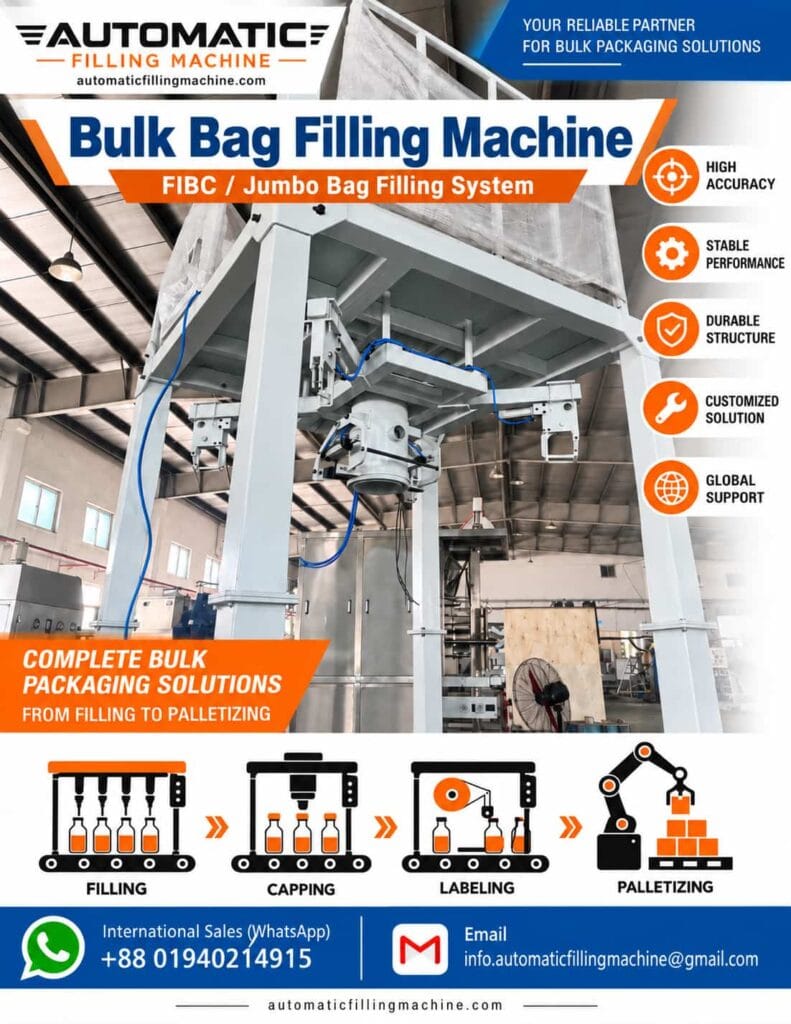
A bulk bag filling machine weighs and fills powders, granules, pellets, and other bulk materials into large FIBC bags. Depending on the market, buyers may also call this equipment a super sack filler, jumbo bag filling machine, big bag filler, ton bag filler, or FIBC filling machine.
automaticfillingmachine.com provides customizable bulk bag filling equipment for different materials, bag dimensions, filling weights, production capacities, and factory layouts. The system can work as a stand-alone filling station or connect with feeding equipment, conveyors, dust collection, pallet handling, and other packaging equipment.
For the correct machine configuration, the most important information is not only bag weight. Material bulk density, flowability, dust level, bag dimensions, filling spout size, and required bags per hour can all affect the final design.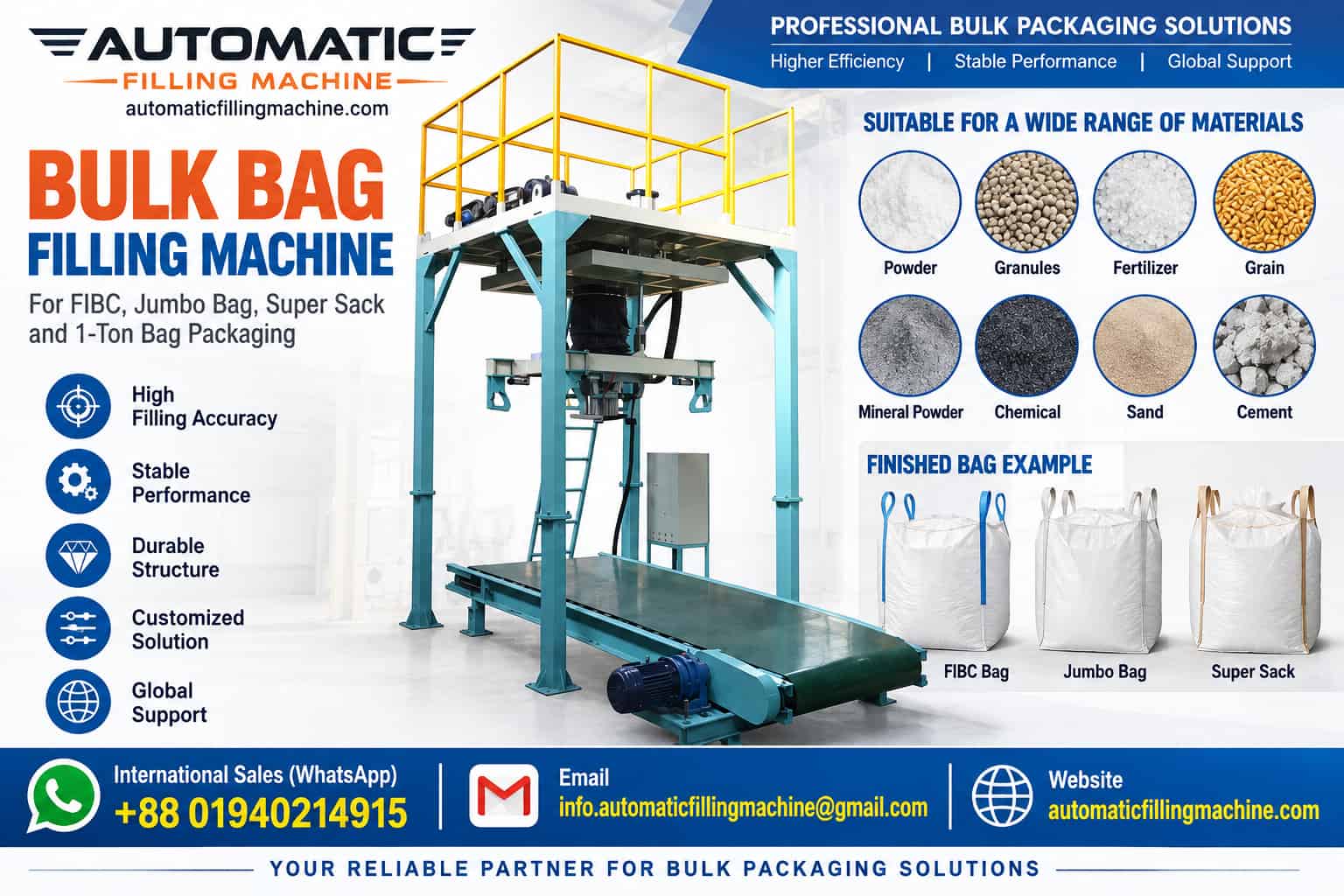
What Is a Bulk Bag Filling Machine?
A bulk bag filling machine is an industrial packaging system that transfers a controlled amount of dry bulk material into an FIBC.
FIBC means Flexible Intermediate Bulk Container. These large industrial bags commonly handle hundreds of kilograms of material during each filling cycle.
A typical system performs four main functions:
- Supports the FIBC bag
- Feeds material into the bag
- Measures the filling weight
- Stops material flow at the target weight
As a result, manufacturers can achieve a more controlled and repeatable filling process than with basic manual filling.
Other Names for a Bulk Bag Filler
Buyers use different names for this equipment in different markets.
| Common Term | Meaning |
|---|---|
| Bulk bag filling machine | General industrial term |
| FIBC filling machine | Technical bag terminology |
| Super sack filler | Common North American term |
| Big bag filling machine | Common international term |
| Jumbo bag filling machine | Common export-market term |
| Ton bag filler | Often used for approximately 1-ton applications |
| Dumpy bag filler | Term used in some UK markets |
| Bulk bag filling station | Complete filling station |
These terms generally describe the same equipment category. However, machine configuration can vary greatly according to material, bag size, filling capacity, and automation requirements.
How Does a Bulk Bag Filling Machine Work?
A typical bulk bag filling system follows a controlled filling process.
First, the operator positions an empty FIBC below the filling head. Next, the operator attaches the lifting loops to the support points and connects the bag inlet to the filling spout.
Then, the filling cycle starts.
Material flows from the upstream hopper or feeding system into the bag. Meanwhile, the weighing system continuously monitors the filling quantity.
For many applications, the machine uses two filling stages.
Fast filling: The feeder supplies material quickly during the main part of the cycle.
Fine filling: As the weight approaches the target, the machine reduces the feeding rate.
Finally, the control system stops material flow when the target weight is reached.
The filled bag can then leave the station by forklift, pallet conveyor, roller conveyor, or another handling system.
Typical Filling Process
Material supply → Bag positioning → Bag fixing → Fast filling → Fine filling → Target weight → Filling stop → Bag removal
This process helps balance filling speed and weighing control.
Why Bag Specifications Matter
One common mistake when buying a FIBC bulk bag filling machine is providing only the target filling weight.
For example, saying “I need a 1000 kg bag filler” is not enough to finalize the machine design.
The manufacturer should also know:
- Bag width
- Bag length
- Bag height
- Filling inlet diameter
- Filling inlet length
- Lifting loop dimensions
- Loop-to-loop distance
- Bag liner type
- Pallet dimensions
- Whether the bag has a discharge spout
These dimensions affect the filling head, support frame, working height, and material handling design.
For the best result, send an FIBC drawing or bag specification sheet when requesting a quotation.
Main Components of a Bulk Bag Filling Station
A complete bulk bag filling station can include several modules.
Filling Frame
The filling frame supports the filling head and the FIBC bag during operation.
The frame dimensions can be customized according to bag height, width, filling weight, and factory space.
Bag Support System
The FIBC normally uses four lifting loops.
The operator connects these loops to the machine before filling. Depending on the automation level, the system can also include assisted bag support or release functions.
Filling Spout
The filling spout guides material into the bag.
A suitable spout design can also help reduce material leakage and control dust around the filling point.
Bulk Bag Filler Hopper
A bulk bag filler hopper provides temporary material storage above the filling station.
The correct hopper size depends on:
- Material bulk density
- Filling weight
- Filling speed
- Upstream material supply
- Available installation height
Weighing System
Load cells measure the filling weight during the cycle.
The control system uses this weight data to switch between fast filling and fine filling before stopping at the preset target.
Feeding System
Different materials require different feeding methods.
Common options include:
- Screw feeder
- Gravity feeder
- Belt feeder
- Vibratory feeder
- Rotary valve
- Customized feeding system
The correct feeder depends on material flowability, bulk density, particle size, dust level, and required output.
PLC and HMI Control
The PLC controls the filling cycle, while the HMI allows the operator to adjust machine parameters.
Depending on the configuration, operators can set:
- Target filling weight
- Fast filling value
- Fine filling value
- Feeding time
- Filling sequence
- Alarm settings
Which Feeding System Should You Choose?
Material behavior has a major effect on machine performance.
| Material Characteristic | Possible Feeding Method | Main Consideration |
|---|---|---|
| Free-flowing granules | Gravity feeding | High material flow |
| Fine powder | Screw feeding | Better feed control |
| Difficult-flow powder | Screw or assisted feeding | Stable material flow |
| Pellets | Gravity or belt feeding | Gentle handling |
| Abrasive material | Application-specific feeder | Wear resistance |
| Dusty powder | Controlled feeding + dust extraction | Cleaner operation |
This table provides general guidance. Final feeder selection should depend on the actual material.
For example, two powders can have the same target bag weight but still require different feeding systems because their bulk density and flowability are different.
Gross Weighing vs Net Weighing
Bulk bag filling systems can use different weighing methods.
Gross Weighing
With gross weighing, the machine weighs the bag while material enters it.
This method combines filling and weighing at the same station and provides a practical solution for many applications.
Net Weighing
With net weighing, the system first measures material in a separate weighing hopper and then releases the measured batch into the FIBC.
This design may suit applications with different speed or production requirements.
The best option depends on material characteristics, required capacity, available space, and project design.
Automatic vs Semi-Automatic Bulk Bag Filling Machine
The correct automation level depends on output, labor availability, factory layout, and budget.
| Feature | Semi-Automatic System | Higher-Automation System |
|---|---|---|
| Bag placement | Operator assisted | Operator or assisted |
| Bag loop attachment | Operator | Assisted options available |
| Weighing | Automatic | Automatic |
| Material feeding | Automatic | Automatic |
| Filling stop | Automatic | Automatic |
| Filled bag removal | Forklift/manual handling | Conveyor integration possible |
| Investment | Lower | Higher |
| Best use | Flexible production | Higher production volume |
A semi-automatic system often provides a good balance between investment and productivity.
However, higher-output plants can add powered conveyors, pallet handling, automatic controls, and downstream packaging equipment.
Materials Suitable for Bulk Bag Filling Equipment
A properly configured bulk bag filling machine can handle many dry bulk materials.
Construction Materials
Common applications include:
- Cement
- Dry mortar
- Sand
- Gypsum
- Calcium carbonate
- Mineral powder
- Construction additives
Chemical and Fertilizer Materials
The system can also handle:
- Fertilizer
- Chemical powders
- Detergent powder
- Pigments
- Industrial additives
- Resins
- Polymer pellets
Minerals
Applications may include:
- Quartz
- Bentonite
- Graphite
- Limestone powder
- Mineral granules
- Ceramic raw materials
Food and Agricultural Materials
With suitable material-contact construction, the machine can also handle:
- Grain
- Rice
- Sugar
- Starch
- Flour
- Seeds
- Feed ingredients
Food applications may require different contact materials and hygiene standards from general industrial powder systems.
Bulk Bag Filling Machine Technical Configuration
The machine can be customized according to the real application.
| Parameter | Typical Configuration |
|---|---|
| Bag type | FIBC / Bulk Bag / Super Sack / Jumbo Bag / Big Bag |
| Filling weight | Customized |
| Common large-bag range | 500–1000 kg or project specific |
| Measurement | Load-cell weighing |
| Feeding method | Screw / gravity / belt / customized |
| Control | PLC + HMI |
| Machine material | Carbon steel / SS304 / customized |
| Bag frame | Adjustable or customized |
| Fast/fine filling | Available |
| Dust extraction | Optional |
| Conveyor | Optional |
| Pallet handling | Optional |
| Vibration system | Optional |
| Upstream feeding | Optional |
| Complete line | Customizable |
Actual filling speed and accuracy depend on the material, feeder, target weight, material supply, and complete machine configuration.
What Affects Filling Accuracy?
A weighing system alone does not determine final accuracy.
Several factors can affect the result.
Material Flow
Stable material flow is easier to control than material that bridges, surges, or changes density.
Feeder Response
The feeder needs to slow or stop quickly enough near the target weight.
Fast-to-Fine Filling Point
Correct cutoff settings help reduce overshoot.
Material in Flight
Some product may continue falling after the stop signal. Therefore, the system needs to account for this material during fine filling.
Machine Stability
Vibration or contact with surrounding equipment can affect weighing performance.
For this reason, the feeder, weighing system, frame, and control logic should work together as one system.
How Bulk Density Affects Machine Selection
Bulk density tells you how much space a certain weight of material occupies.
For example, a low-density powder needs more volume than a high-density mineral for the same 1000 kg filling weight.
Therefore, bulk density affects:
- Hopper size
- Bag volume
- Filling time
- Feeder size
- Material flow
- Installation height
When possible, provide bulk density in kg/m³ when requesting a machine.
Dust Control for Powder Filling
Dust can become a major issue when filling cement, mineral powder, flour, or fine chemicals.
A dust-control system may include:
- Enclosed filling connection
- Dust extraction port
- Central dust collector connection
- Sealed filling spout
- Controlled material feeding
A suitable dust-control design can help improve the working environment and reduce material loss around the filling station.
Bag Inflation and Densification
Some products benefit from extra bag-handling functions.
Bag Inflation
Bag inflation helps open and shape the empty FIBC before filling.
This can improve bag positioning and help material enter more evenly.
Vibration or Densification
Light or aerated materials can trap air inside the bag.
Therefore, a vibration or densification system can help settle the material and improve bag stability.
However, not every product requires these options. The machine should be selected according to the actual material.
How to Choose the Right Bulk Bag Filling Machine
Before selecting equipment, prepare the following information.
Material Name
Provide the exact material instead of simply saying “powder.”
Bulk Density
Provide the approximate value in kg/m³ if available.
Filling Weight
Common requirements may include 500 kg, 800 kg, 1000 kg, or another customized value.
Bag Dimensions
Provide bag width, length, height, inlet dimensions, and lifting loop information.
Required Capacity
State the required number of bags per hour.
Material Feeding Method
Explain how the product reaches the filling machine.
Examples include:
- Silo
- Storage hopper
- Screw conveyor
- Belt conveyor
- Pneumatic conveying system
- Manual feeding
Dust Level
Tell the supplier whether the product creates low, medium, or high dust.
Filled Bag Removal
Common methods include:
- Forklift
- Roller conveyor
- Pallet conveyor
- Powered conveyor
Providing this information helps the supplier design the complete system instead of quoting only a standard filling frame.
1 Ton Bag Filler: What Information Is Required?
A 1 ton bag filler usually refers to a machine designed to fill around 1000 kg into each FIBC.
However, “1 ton” does not define the entire machine.
For a suitable proposal, provide:
Material: Cement, fertilizer, resin pellets, mineral powder, etc.
Target weight: 1000 kg
Bulk density: kg/m³
Bag dimensions: Width × Length × Height
Bag inlet size: Diameter and length
Required capacity: Bags per hour
Material supply: Silo, hopper, screw conveyor, etc.
Dust control: Required or not
Bag removal: Forklift or conveyor
This information gives the engineering team a much better basis for machine selection.
Optional Equipment for a Complete Bulk Bag Filling Line
A bulk bag filler can work as a stand-alone system or become part of a complete packaging line.
Optional equipment may include:
- Storage hopper
- Screw conveyor
- Belt conveyor
- Vibratory feeder
- Dust collector
- Roller conveyor
- Pallet conveyor
- Bag vibration system
- Pallet handling equipment
- Wrapping machine
- Customized control system
Therefore, customers can start with a simple bulk bag filling station or build a more automated packaging line.
Bulk Bag Filling Machine vs Open Mouth Bagging Machine
These machines handle different packaging sizes.
| Bulk Bag Filling Machine | Open Mouth Bagging Machine |
|---|---|
| Fills FIBC and jumbo bags | Fills smaller open-mouth bags |
| Large filling weights | Smaller industrial bag weights |
| Uses FIBC lifting loops | Uses open-mouth bag support |
| Forklift/pallet handling common | Conveyor and sewing often used |
| Suitable for bulk transport | Suitable for smaller packaged products |
If your target bag size is 25 kg or 50 kg, an open mouth bag filling machine may be more suitable.
If you need approximately 500–1000 kg FIBC bags, a bulk bag filling machine is usually the correct equipment category.
Bulk Bag Filler vs Valve Bag Filling Machine
A valve bag filler normally fills smaller industrial bags through a valve opening.
Common applications include cement, dry mortar, mineral powder, and other fine products.
A bulk bag filler, in contrast, handles much larger FIBC bags.
Therefore, the correct machine depends first on bag type and target filling weight.
Why Choose automaticfillingmachine.com?
automaticfillingmachine.com provides industrial filling and packaging solutions for different bulk materials.
Instead of selecting equipment only by bag weight, we review the complete production process.
We consider:
- Material characteristics
- Bulk density
- Bag specifications
- Filling weight
- Required bags per hour
- Feeding method
- Factory layout
- Dust-control requirements
- Material-contact requirements
- Required automation level
Based on this information, we can configure the filling frame, weighing system, feeder, controls, conveyors, and optional handling equipment according to the project.
Customers can also provide factory layout drawings, FIBC drawings, material information, and production videos to help us prepare a more suitable solution.
Information to Send Before Requesting a Quotation
For a faster and more accurate proposal, please provide:
| Required Information | Example |
|---|---|
| Material | Calcium carbonate powder |
| Bulk density | ___ kg/m³ |
| Filling weight | 1000 kg/bag |
| Bag dimensions | ___ × ___ × ___ mm |
| Bag inlet size | ___ mm |
| Required capacity | ___ bags/hour |
| Required accuracy | ___ |
| Feeding source | Silo / hopper / conveyor |
| Dust level | Low / medium / high |
| Bag removal | Forklift / conveyor |
| Material-contact requirement | Carbon steel / SS304 / other |
| Power supply | Country/site standard |
| Factory layout | Drawing if available |
This information helps reduce unnecessary back-and-forth during machine selection.
Frequently Asked Questions
What is a bulk bag filling machine?
A bulk bag filling machine fills and weighs powders, granules, pellets, and other dry bulk materials into large FIBC bags.
What does FIBC mean?
FIBC stands for Flexible Intermediate Bulk Container.
Is a super sack the same as an FIBC?
In most purchasing situations, yes. Super sack, bulk bag, jumbo bag, and big bag commonly describe FIBC-type packaging.
Can the machine fill 1000 kg bags?
Yes. The system can be configured as a 1 ton bag filler for approximately 1000 kg per bag.
Can one machine handle different bag sizes?
Yes, depending on the required size range. An adjustable support frame can help accommodate different FIBC dimensions.
Which feeder is best for powder?
There is no single best feeder for every powder. Screw feeding often works well for many powders, while gravity, belt, vibratory, or other systems may suit different materials.
Can the machine handle granules and pellets?
Yes, if the feeder and product-contact design match the material.
Can the machine connect directly to a silo?
Yes, in many projects. However, silo height, outlet design, feeder arrangement, and material flow need to be checked.
Does the machine need compressed air?
Some configurations use pneumatic components, so air requirements depend on the selected machine design.
Can dust collection be added?
Yes. Dust extraction connections and related equipment can be included when required.
Can filled bags move automatically?
Yes. Roller conveyors, pallet conveyors, or other handling equipment can be added.
How can I get an accurate quotation?
Send the material name, bulk density, filling weight, bag dimensions, required capacity, feeding method, and factory layout.
Request a Bulk Bag Filling Machine Solution
Looking for a bulk bag filling machine, FIBC filling machine, super sack filler, jumbo bag filling machine, big bag filling station, or 1 ton bag filler?
Send automaticfillingmachine.com the following information:
- Material name
- Bulk density
- Filling weight
- FIBC dimensions
- Bag inlet dimensions
- Required bags per hour
- Required filling accuracy
- Feeding method
- Dust-control requirements
- Factory layout
We can review your application and recommend a suitable bulk bag filling system for your production process.