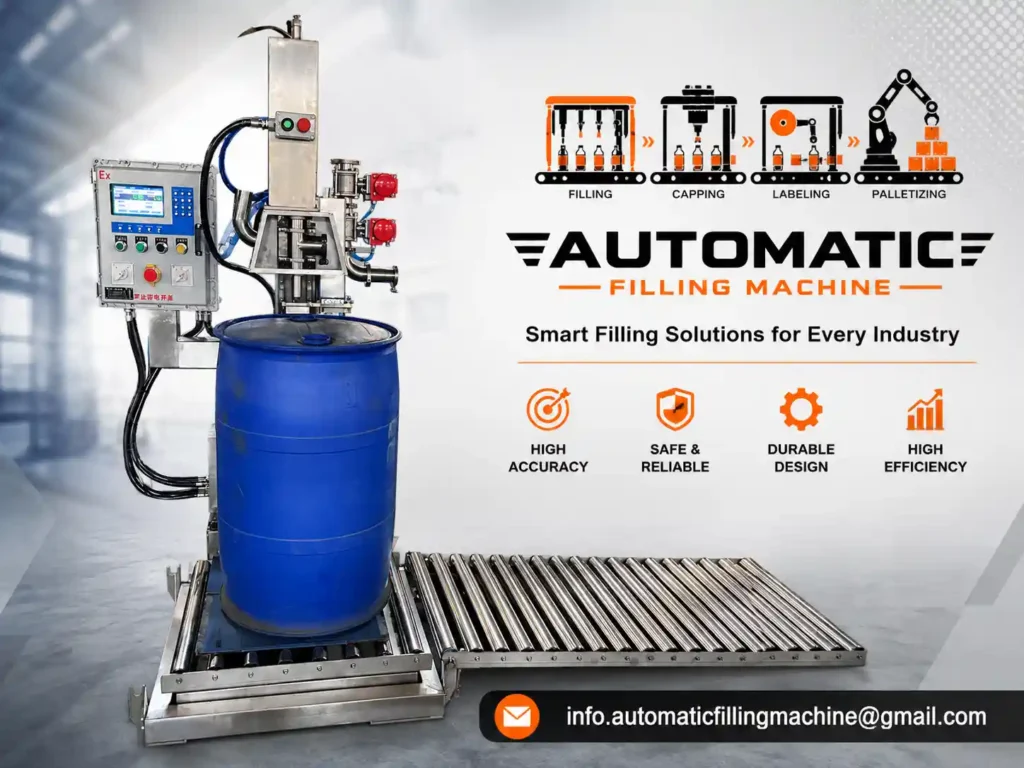
Equipment Photo Gallery
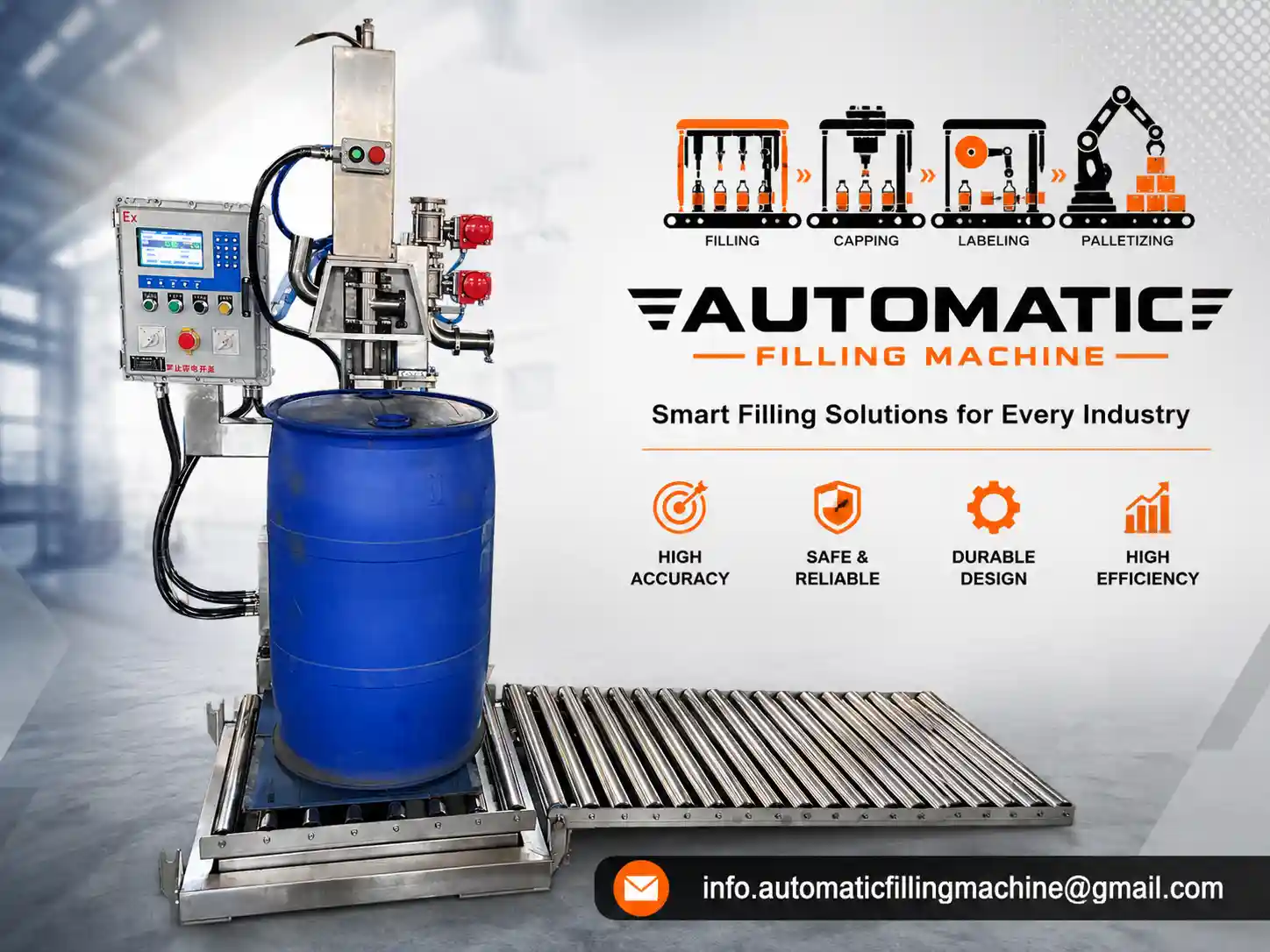
Choosing a 200L drum filling machine starts with your production requirements. Drum capacity alone does not define the filling weight, nozzle arrangement or handling system. This checklist explains what to measure before requesting a configuration from a supplier.
For available equipment and automation options, visit our main drum filling machine product page.
1. Measure the actual drum
First, record the drum height, diameter, opening size and bung position. Include photos of the empty container and its closure. Steel and HDPE drums can have different shapes even when their stated capacity is similar. Therefore, the supplier should check nozzle access, platform size and conveyor clearance against your actual container.
Also explain whether drums arrive individually or on pallets. This determines how the operator or handling system presents each opening to the filling head.
2. Define net weight using your product data
A weighing filler measures mass. A 200L container does not mean that every liquid has a target weight of 200kg. If your packaging requirement is in litres, establish the target net weight using the product density at the filling temperature.
For example, 200 litres of a liquid with a density of 0.85kg/L corresponds to 170kg. This is an illustrative calculation, not a recommended fill level. Confirm usable container capacity, required headspace and the actual product density before setting the machine.
3. Describe the liquid and its supply
Next, provide the liquid name, viscosity, temperature and any tendency to foam or contain solids. Explain whether product comes from a storage tank, pump or elevated vessel. Include the distance and height difference between the supply and filling station.
These details help the supplier assess the pump, valve, hoses and wetted materials. For chemicals, supply the safety data sheet and your site requirements. Hazardous-area protection must be assessed for the installation; it should not be assumed from a machine photograph.
4. Compare complete cycle time
Specify the required finished drums per hour. Then identify every operation included in that target: positioning, opening, filling, nozzle withdrawal, capping and transfer. A quoted filling time may exclude several of these steps.
For a planning example, 30 completed drums per hour allows an average of 120 seconds per finished drum. This is a production calculation, not a machine performance claim. Ask the supplier to demonstrate how the proposed layout meets the target under the agreed test conditions.
5. Decide which handling tasks to automate
A semi-automatic station normally relies on an operator to position the drum and start the filling cycle. An automatic line can coordinate container transfer and filling, while other operations depend on the agreed scope. Therefore, list each task you want automated rather than relying on the word “automatic.”
Read our semi-automatic drum and IBC operation guide for operator-assisted workflows. If both container formats are needed, use the drum versus IBC comparison to review handling differences.
6. Confirm nozzle access and cleaning
The nozzle must fit the opening and suit the liquid. Discuss foam, splashing, residual drips and the required lance movement. Our short versus long nozzle guide explains these choices in more detail.
Also describe product changeovers. Agree how the nozzle, valve, pump and hoses will be drained and cleaned. Where products are incompatible, assess dedicated product-contact components or a suitable validated cleaning process.
7. Request a comparable quotation and acceptance test
Finally, ask each supplier to quote the same scope. The proposal should identify included equipment, container formats, product-contact materials, utilities, layout dimensions and excluded operations.
- Define the test liquid, temperature and target net weight.
- Agree how filling accuracy will be measured across repeated fills.
- Measure complete cycle time with the stated handling operations.
- Review nozzle dripping, changeover access and operator controls.
- Record the configuration tested and the documents supplied.
These records make it easier to compare proposals and check the delivered equipment.
Send your 200L drum filling requirements
Prepare your liquid data, drum photographs, target net weight, required output and factory layout. Include available power, compressed air and delivery destination. Then request a tailored quotation from AutomaticFillingMachine.com. Our team can review these details before proposing a suitable drum filling configuration.